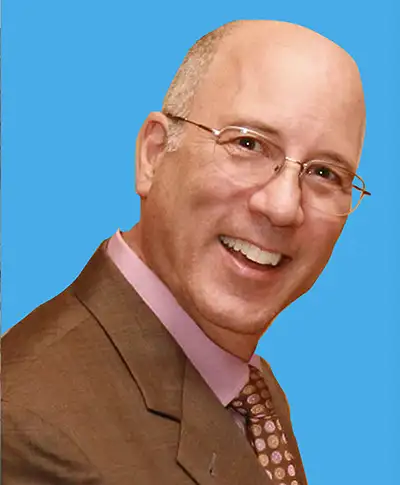
Attorney (Retired)
Ted practiced law in the San Francisco Bay Area, focusing on business transactions, contracts, real estate, and estate planning. He is a well-recognized attorney and was listed in the first edition of Marquis Who’s Who in American Law.
Author
Ted is the author of 13 published books, with several more in development. One forthcoming title, scheduled for release in December 2026, of which he is co-author, is expected by its publisher, The Walt Disney Company, to achieve New York Times bestseller status.
Adjunct Professor (Retired)
Ted served as an adjunct professor of business and real estate, teaching both undergraduate and graduate courses at Golden Gate University in San Francisco. He also taught at City College of San Francisco and College of Marin.
Hobbies
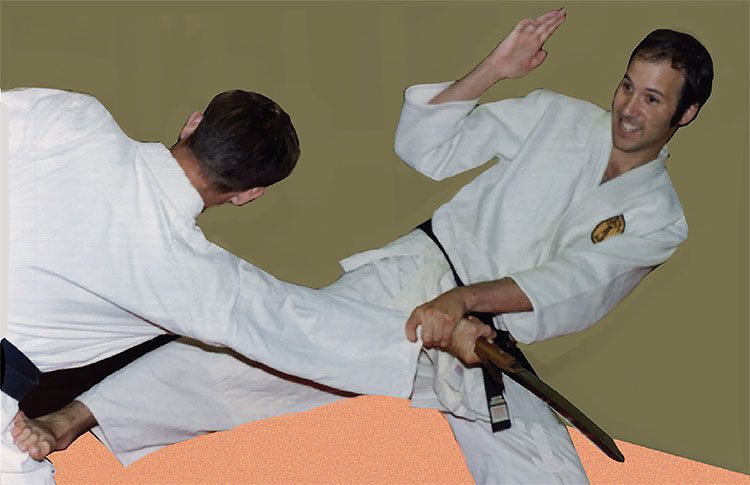
Ted continues to teach ju-jitsu self-defense on occasion (he holds a third-degree black belt), and enjoys magic and woodworking. The picture below is from Ted’s black belt test (way back when he had hair!).
Ted’s Life
Medical Issues
At 26, I was newly married, in my second year of law school, and pursuing a master’s in business administration from a university in Silicon Valley. My mother died unexpectedly at age 32 from a heart attack. Little did I know, I had inherited my mother’s bad arteries, and life was about to take an unexpected turn.
At the end of my second year in law school, I suffered my first heart attack, and the next year, at age 27, I followed with two more heart attacks. (The doctors told my wife to say goodbye; they didn’t expect me to survive the night.) I wrote my first book while recovering from a heart attack, as I couldn’t attend class. I wrote California Real Estate Law: Cases and Materials for extra credit instead of attendance that semester. (After 45 years, the book is going strong and now in its tenth edition.)
I did not feel like half a man because I didn’t have the strength or endurance of my peers (although I did for about a year at age 26 with my first heart attack). I found that family and friends are loyal, but don’t know how to react to you. As long as you are comfortable with yourself and put them at ease, they will see you as a person, not your disease. My adjustments and how I accepted life and found great joy in living led me to write two books, Burdens of the Heart and Live, and Don’t Let Cancer Become Your Life.
Sadly, at age 28, I underwent open-heart surgery, which was still very new, as insurance companies had just started covering this operation. It was so new that when I went to another hospital a few months later, all the one hundred nurses came to visit and see an open-heart surgery scar. The operation was successful, but the doctors said, at best, that I had 18 months to live and get my affairs in order. My affairs – all I had were a ton of law books, a car, and a few thousand dollars in the bank. You can adjust to anything. Fortunately, I could accept my illness without a problem.
I took the Dr. Meyer Friedman Course, Type A/Type B Behavior. At the time I started the course, I was working five days a week as an attorney, teaching two nights a week as an adjunct professor at a local university, and considering writing a second book. The course made me realize I was caught up in a work trap, where I was getting my rewards from achievement, not from family or what mattered in life. I changed my law practice to four days a week (and surprisingly, my income didn’t go down. I just rejected the “bad” cases). On my day off, I taught a night class. I spent the rest of my time with my family and made sure I attended all my son’s school games and activities.
Life After Retirement
Finally, when I completely retired from law and teaching, I began writing more books. My wife and I also moved from California to be with our son and his family. I found that love and friendship are always there with family and friends, but you must be there for day-to-day activities (in person or by video conference) to maintain closeness.
Old Style Author’s Life
You will probably laugh when I describe how my publisher handled my first book in the “horse and buggy days” before mini-computers and desktop devices. I hand-typed my 300-page manuscript double-spaced and sent the original to the publisher, keeping a somewhat messy carbon copy for myself. Two months later, a box arrived with 300 pages. Each page had sticky notes attached. There were two to six Post-it notes per page from their Proofreader, noting punctuation issues, misplaced words, or grammatical errors. I read, answered, and initialed each of those thousand sticky notes. Actually, there were 600 pages, once set for me, and one set I had to return.
Once I mailed it all back, I was given galley proofs to read the typeset pages of my book. After carefully reading the material, initialing, and “signing away my life;’ I returned the packet. Months later, the publisher sent me the final pages of my typeset books, and I had to index them. It took over 100 hours and three boxes of 3×5 cards. I sure do not miss the “good old days.”
Conclusion
I am closing with a quote from Immanuel Kant, who wrote that a good life is one where we are
“doing what we love, knowing someone to love, and having a sense of purpose.”
We should also try to be compassionate and avoid harming others. I have always found his philosophy a guiding principle.